The Account Wars: What Happens When Dollar Accounts Leave the Bank
Announcement
Written by Emily Sun, translated by Victoria Ow, Bitget Wallet
For as long as bank accounts existed, nobody had to ask who owns them. The answer was structural, not debatable:
the bank does.
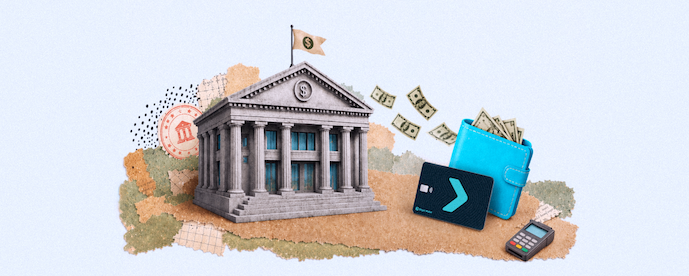
You open an account, you see a balance, and you assume the money is yours. Legally, it isn't. A bank account is a debt instrument. The bank takes ownership of your funds and gives you a claim against them. In exchange, it operates under licensing requirements, capital adequacy rules, and client fund segregation obligations. That arrangement ran for decades without anyone questioning it – because no other entity could both hold money and answer to a regulator.
Stablecoins pulled those two things apart. When a dollar can sit in a blockchain address instead of on a bank's balance sheet,
the question of who holds the money separates from the question of who is regulated. That's not a technical footnote. It's a structural loosening. For decades, account ownership was never contested because there was only one possible answer. Now it's an open question every company has to answer for itself – and live with the consequences.
The KAST terms-of-service controversy in July 2026 was the first time that question got put in front of everyone.
The KAST controversy
On the surface, KAST looked like a wording dispute. When users topped up their card account with USDC, the terms
defined transfer as a sale, not a deposit. Treating it as a PR misstep misses the signal.
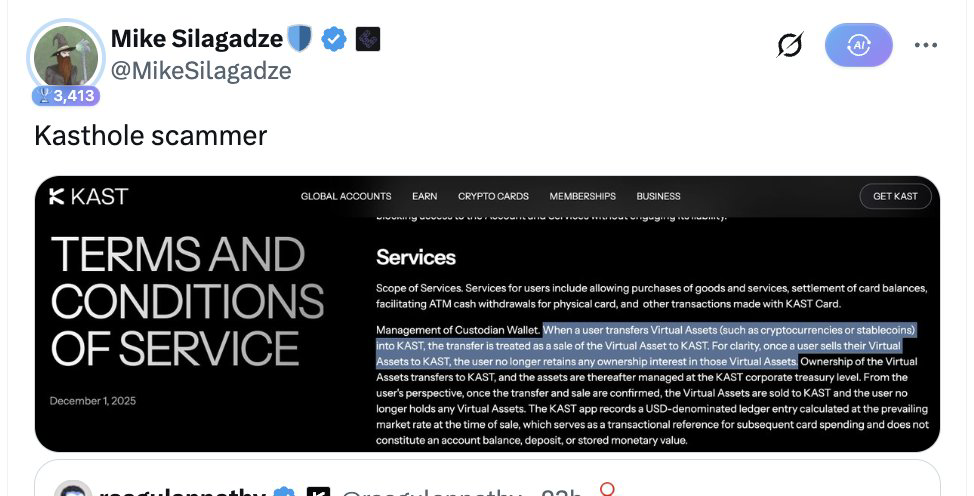
Here's why the distinction matters. If a top-up is a deposit, the money still legally belongs to you and the company holds it on your behalf. If it's a sale, you've transferred ownership of that stablecoin to KAST. The funds enter the corporate treasury. The balance in your app is a payment obligation the company owes you –
a digitized IOU.
While the company operates normally, you'd never notice. But if it hits a liquidity crisis or insolvency, the difference determines whether you recover your money as an asset owner or wait in line as a creditor. KAST's terms capped company liability at $500 – which tells you roughly where users sat in that structure.
Why such a structure exists
Reading this as legal sloppiness underrates how deliberate it was. A fintech that holds user funds long-term gets classified as operating an e-money or stored-value business in most jurisdictions. That means an EMI license in Europe, client fund segregation, capital adequacy requirements, and continuous auditing. Those licenses are expensive and nearly impossible to replicate cheaply across borders. Defining top-ups as sales sidesteps the entire framework. If the company bought the asset, it's the company's asset – not client funds. The rules governing client funds don't apply.
It also rewrites the revenue model. Once money enters the corporate treasury, it can be deployed into short-term Treasuries or money market funds. At 4–5% yields, $100 million in idle balances generates $4–5 million a year – whether or not users ever spend a cent. That's Circle and Tether's reserve model, transplanted into a neobank account structure. Most products need users to transact to make money. This one earns when they do nothing.
Cheaper compliance, a better business model. The cost:
users move from asset owners to counterparties on a corporate balance sheet.
How we got here
To understand why this matters now, it helps to look at what dollar accounts actually do for most of the world:
1. Dollars as survival, not investment
Explain "dollar account" to an American and you'll get answers about payroll, rent, or brokerage. For much of the world, the stakes are different. Argentina's inflation topped 200% in 2023 – hold your salary in pesos for a few days, and your purchasing power will visibly erode. The first move after payday is converting to dollars. Nigeria runs a parallel system: official and street exchange rates coexist, importers can't source enough dollars through formal channels, and USDT has become a de facto settlement tool. Chainalysis has ranked Nigeria among the world's most active crypto markets for years running. Not speculation –
dollar scarcity.
2. Dollars as income
The World Bank and ILO show India, the Philippines, Pakistan, and Bangladesh as major exporters of digital labor. Developers, designers, and freelancers earn dollars through Upwork, Fiverr, or directly from overseas SaaS companies – with receiving accounts still trapped in local financial systems. A Filipino designer waits days for a US client's payment. A Pakistani developer pays over 5% on a cross-border transfer.
Global personal remittances hit roughly $905 billion in 2024, with about $685 billion flowing to low- and middle-income countries. The average settlement still takes days at around a 6% fee. Work went global two decades ago. Accounts didn't.
So why didn't banks fill the gap? Not unwillingness –
cost structure. Banks price by country. Internet-era dollar demand is generated globally. Each additional jurisdiction means a full stack of KYC, AML screening, FX controls, and capital requirements. You can't amortize that across a freelancer earning a few hundred dollars a month, or an Argentine family swapping their salary. The gap went to companies outside the banking system.
The first generation of the dollar account and its limitations
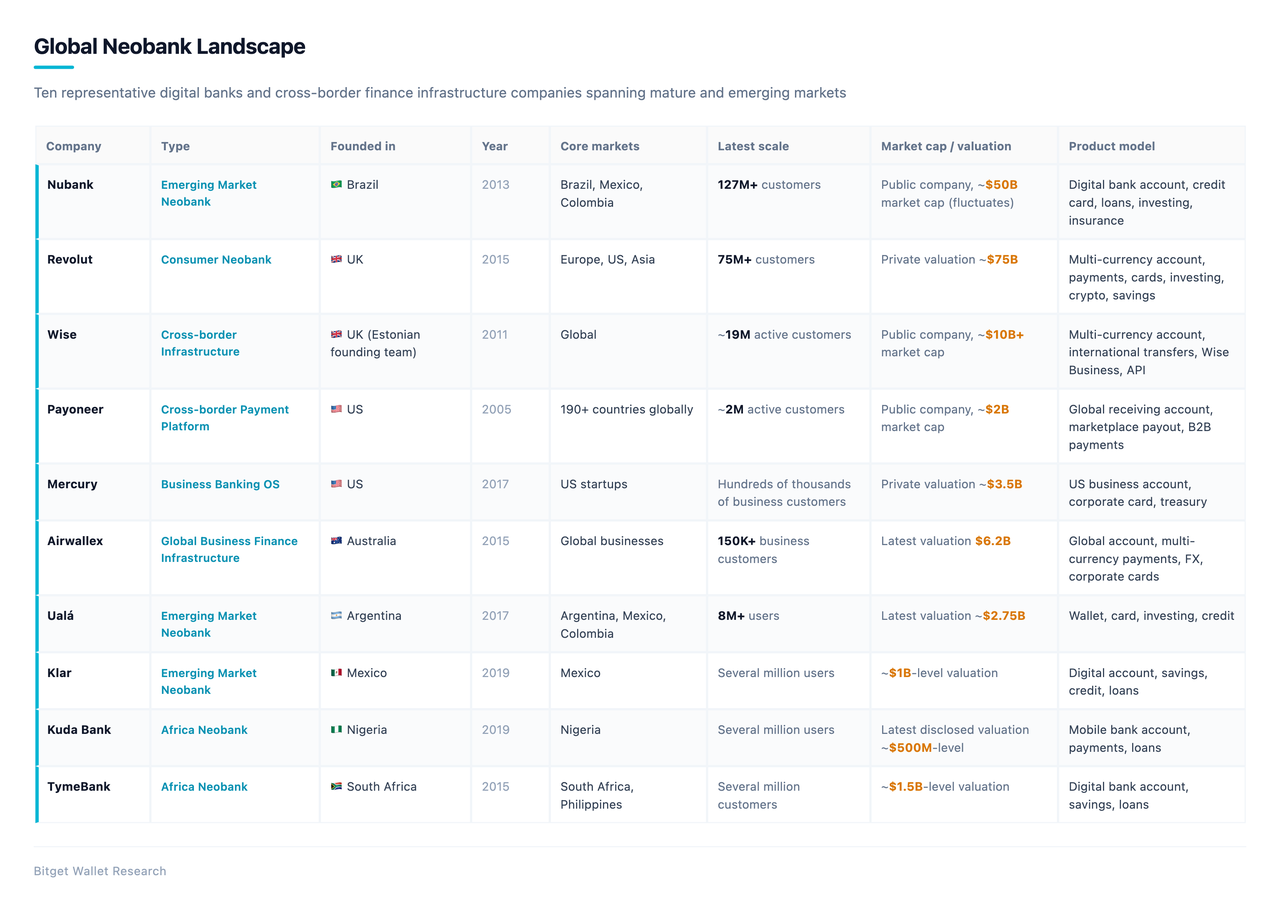
Nubank, Revolut, Wise, Payoneer, and Mercury grew into that gap. None of them reinvented the dollar. They repackaged the bank.
-
Wise splits a cross-border transfer into two local transfers, netting through a global account network to bypass correspondent banking
-
Mercury productized the US business bank account, giving a founder in Singapore or Brazil a complete US financial entry point
They changed onboarding and transfer costs. But the money still sat in regulated commercial banks, and regulatory responsibility still sat with those banks. They were an internet layer on top of the banking system – not something outside it.
That's the ceiling. However modern the interface, as long as fund sovereignty stays with the bank, the compliance cost of serving small, high-frequency, cross-border users doesn't go away. The underlying problem – banks don't want to serve these people cheaply – stays unsolved.
What eventually broke the ceiling wasn't better product design but a change at the asset layer.
Stablecoins unbundled the bank
Tether launched USDT in 2014. Circle and Coinbase launched USDC in 2018. Nominally, new digital dollars. Actually, something deeper: the dollar could now exist independently at a blockchain address, outside any bank account.
For a Nigerian founder, that means receiving dollars from a US client without a US bank account. For an Argentine family, converting a salary to digital dollars without local bank approval. But the strongest effect wasn't faster transfers or lower fees. It was that three functions banks had always bundled together –
account assets, settlement, and payments – could finally be separated and run by different parties.
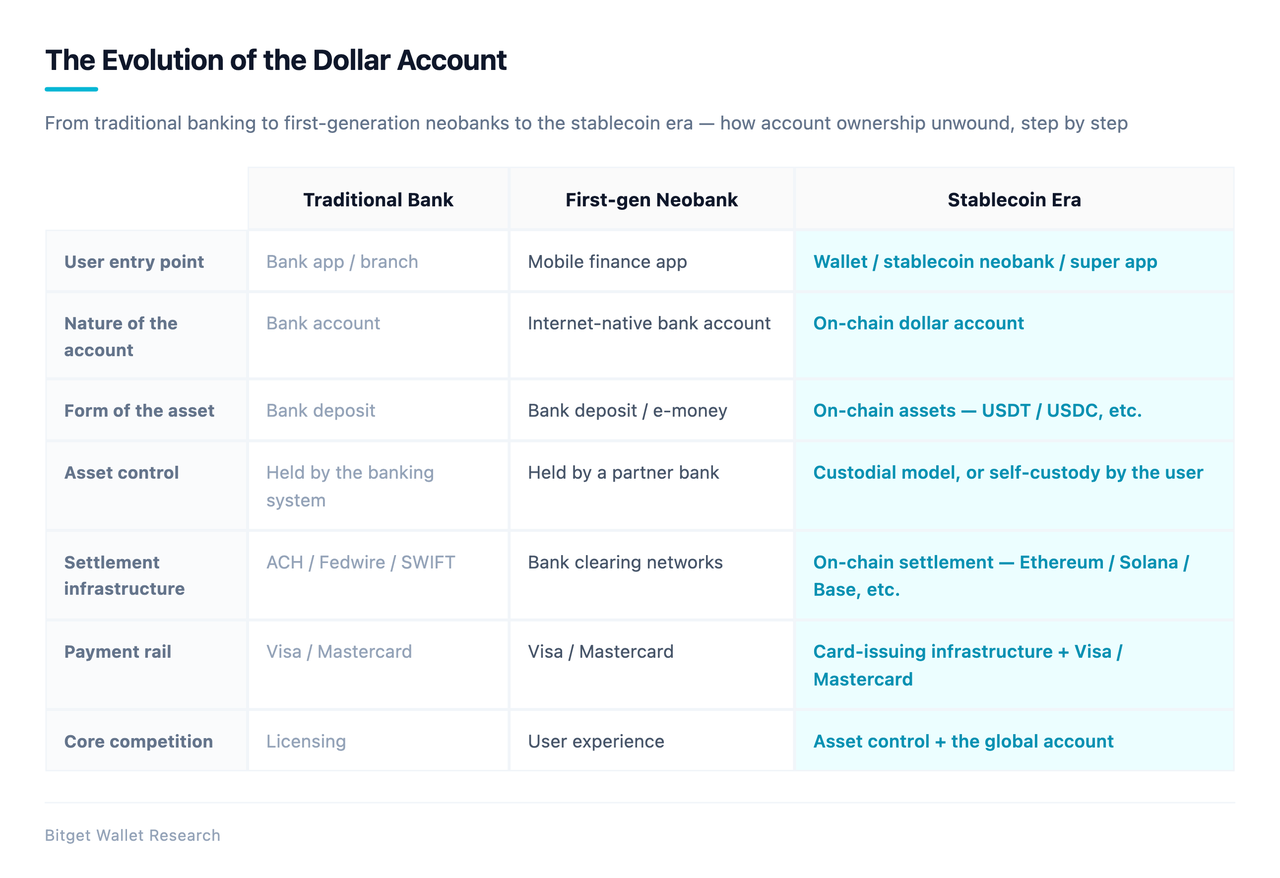
In the bank era, these were effectively one thing. Money sits at the bank. The bank settles through ACH, Fedwire, or SWIFT. Spending runs through Visa and Mastercard, connecting bank accounts to merchants. One regulated entity carried all three layers, so regulators only had to watch the bank.
Now the asset layer is
USDT or
USDC onchain. The settlement layer runs in real time on Ethereum, Solana, or Base. The payment layer relies on card infrastructure to convert digital dollars into something merchants accept. Three layers, three different participants: wallet, chain, card network. And regulators had never needed to work out how the responsibility that once sat on a bank should be redistributed across three parties.
That unresolved question changed what second-generation neobanks compete on. The first generation competed on integrating with banks more smoothly. The second generation competes on finding a responsibility structure for each layer that regulators will accept.
RedotPay connects stablecoin accounts directly to global cards. Gnosis Pay uses smart contract wallets to reach the Visa network while keeping spending authority with the user. Ether.fi Cash merges stablecoins, staking yield, and a spending account into one onchain account. Plasma links onchain accounts to Bridge, Stripe's fiat infrastructure arm.
While they all look like they're doing the same thing – building a better dollar account – the real divergence is how they answer the ownership question.
Full ownership of your money
Ether.fi Cash, Avici, Plasma, and Bitget Wallet run a near-mirror-image approach. Same Visa or Mastercard connectivity, same stablecoin spending. One shared principle: build the business on providing payment services, not on owning user assets. Never become the owner of funds at any layer.
In practice, that means reducing the window of time during which you control user money to as close to zero as possible. Ether.fi Cash uses smart contracts to lock assets as spending collateral, with the actual payment drawn on issuer credit rather than pulling stablecoins from the wallet. Plasma hands fiat conversion to licensed institutions like Bridge and handles only the onchain account and network. Avici runs virtual accounts through banking partners, converting fiat to stablecoins in the user's wallet on arrival rather than parking it on-platform.
The shared logic: rather than seeking a license covering wallet, bank, and payment institution simultaneously, hand each layer's responsibility to whoever is best positioned to carry it – and easiest for regulators to understand.
Bitget Wallet Card takes this further, splitting account, funds, and payment into three layers with distinct regulatory obligations rather than trying to cover all of them with one entity.
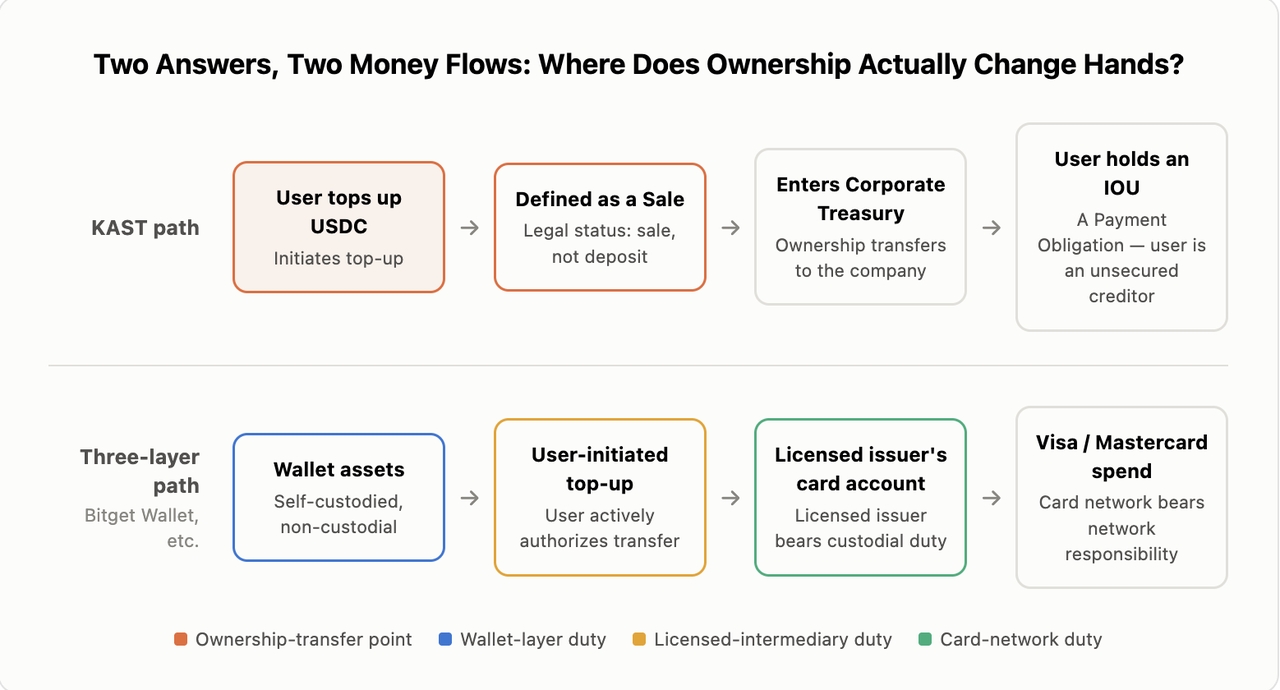
Bitget Wallet
stays non-custodial throughout. Your USDT and USDC live at your own wallet address, private keys in your hands. The platform cannot and does not move or pool your funds. At the wallet layer, no custody relationship exists – so no custody framework applies.
Funds enter the second layer only when you actively top up a card account managed by a licensed issuer. That layer sits with the licensed institution, which meets local payment regulations as a matter of course.
The third layer is the Visa or Mastercard global merchant network, converting funds into real-world spending. That regulatory responsibility stays with the card networks.
No single link carries the full regulatory weight of all three roles. Control of your assets stays with you – at the cost of one extra authorization step. That step looks like a small hit to convenience. What it buys is your position in the worst case: not a creditor in a liquidation queue, but a private key holder whose assets never left their own address.
KAST trades asset ownership for regulatory simplification. Bitget Wallet and its peers trade a slightly heavier UX for precise responsibility separation and retained user control. Two solutions to the same question. What decides which one runs further isn't product polish – it's what regulators are actually watching.
What regulators are actually watching
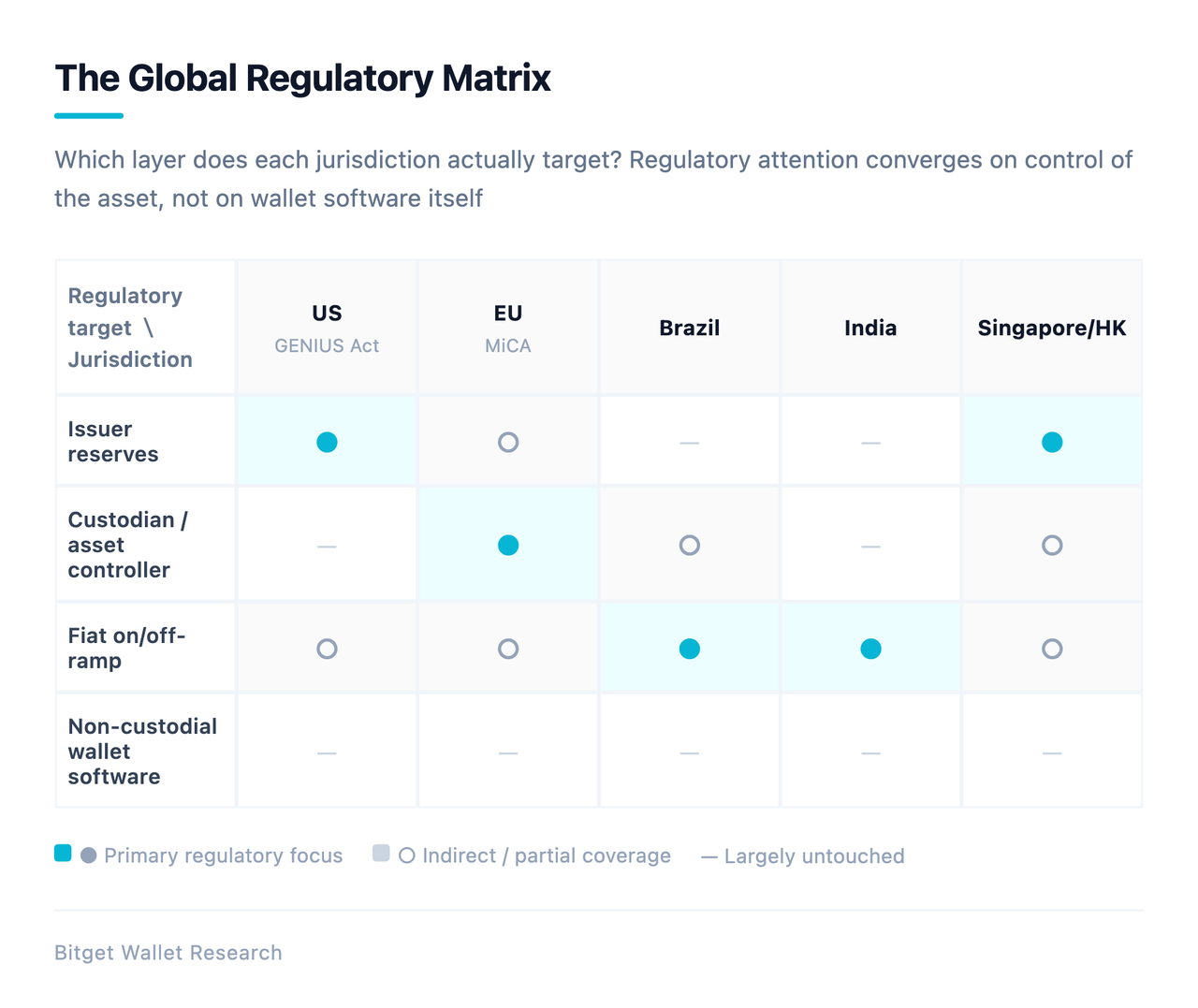
Line up the major economies' stablecoin policies from the past few years and a pattern emerges: almost none of them treat wallet software as the regulatory target. There's only one question they care about.
Who controls the money, and whose balance sheet is it sitting on right now?
-
United States: The GENIUS Act (2025) didn't ban stablecoins or non-custodial wallets. It focused on issuers: reserves must be safe, audited, and cannot pay interest directly to holders. The question being asked is who issues the dollar – not who wrote the wallet.
-
Europe: MiCA took a different route but landed in the same place. It didn't require every wallet to get a financial license. It targeted crypto asset service providers: if you custody client assets, execute trades on their behalf, or manage funds, you need authorization. Pure software with user-held keys gets relative restraint. Europe watches control of assets, not the software carrying them. This is exactly why a KAST-style ownership transfer runs into harder scrutiny, while non-custodial layering fits more naturally into existing frameworks.
-
Brazil and India: Emerging markets focus on on- and off-ramps and capital flows. Brazil's central bank built Pix into one of the world's most successful real-time payment networks while gradually tightening oversight of stablecoin-to-fiat conversion – the goal being that funds ultimately ramp in and out within the regulated system. India didn't restrict wallets directly. It raised the cost of onchain transactions through capital gains tax and withholding, putting the pressure on fund movement rather than the software layer.
-
Singapore and Hong Kong: Both countries welcome stablecoin innovation while requiring issuers to be licensed and reserves secured, and sorting wallet, payment, and custody roles into distinct frameworks.
Many jurisdictions, many specific rules, one shared logic: regulators care less and less which chain the money runs on, and more and more about whose balance sheet it's on right now. Which means what determines a neobank's regulatory treatment isn't its marketing. It's the fund structure. KAST positioned itself as a stablecoin-backed dollar account rather than a crypto wallet – but its fate turns on the "top-up equals sale" clause, not the words it chose to describe itself. Regulation didn't stop second-generation dollar accounts. It changed how responsibility gets distributed behind them. Whoever sits closest to user funds sits closest to the corresponding obligations. No amount of elegant drafting changes that.
Where this ends
For twenty years, the internet reshaped nearly every industry and never really touched banking. Not because the technology wasn't ready – because account ownership never budged. As long as ownership was anchored to a bank's balance sheet, however good the app looked, it was a layer in front of a bank. Stablecoins loosened that anchor. But loosening it doesn't answer who's responsible. It just converts a question with a default answer into one every company must answer itself and own the consequences of.
The gap between KAST and Bitget Wallet, Ether.fi Cash, and Plasma is the clearest expression of that so far. One trades asset ownership for regulatory simplification and reserve yield, at the cost of turning users into creditors. The other trades some convenience for three-layer separation with distributed licensing, keeping asset control with users. Neither is wrong. They've chosen different coordinates on the axes of regulatory friendliness and user asset sovereignty – and both markets and regulators are still watching which survives longer.
Push the logic one step further and a new problem comes into view:
onchain dollars are only going to multiply.
As of January 2026, USDT exceeds $180 billion and USDC exceeds $70 billion. PayPal has PYUSD. Open Standard launched OUSD. Large US banks are discussing jointly issued tokenized deposits. When dozens of digital dollars circulate simultaneously, what users need clearly isn't more stablecoin names to memorize – just as nobody today cares which carrier's network sits behind their mobile payment. Infrastructure recedes from view. Stablecoins won't be an exception.
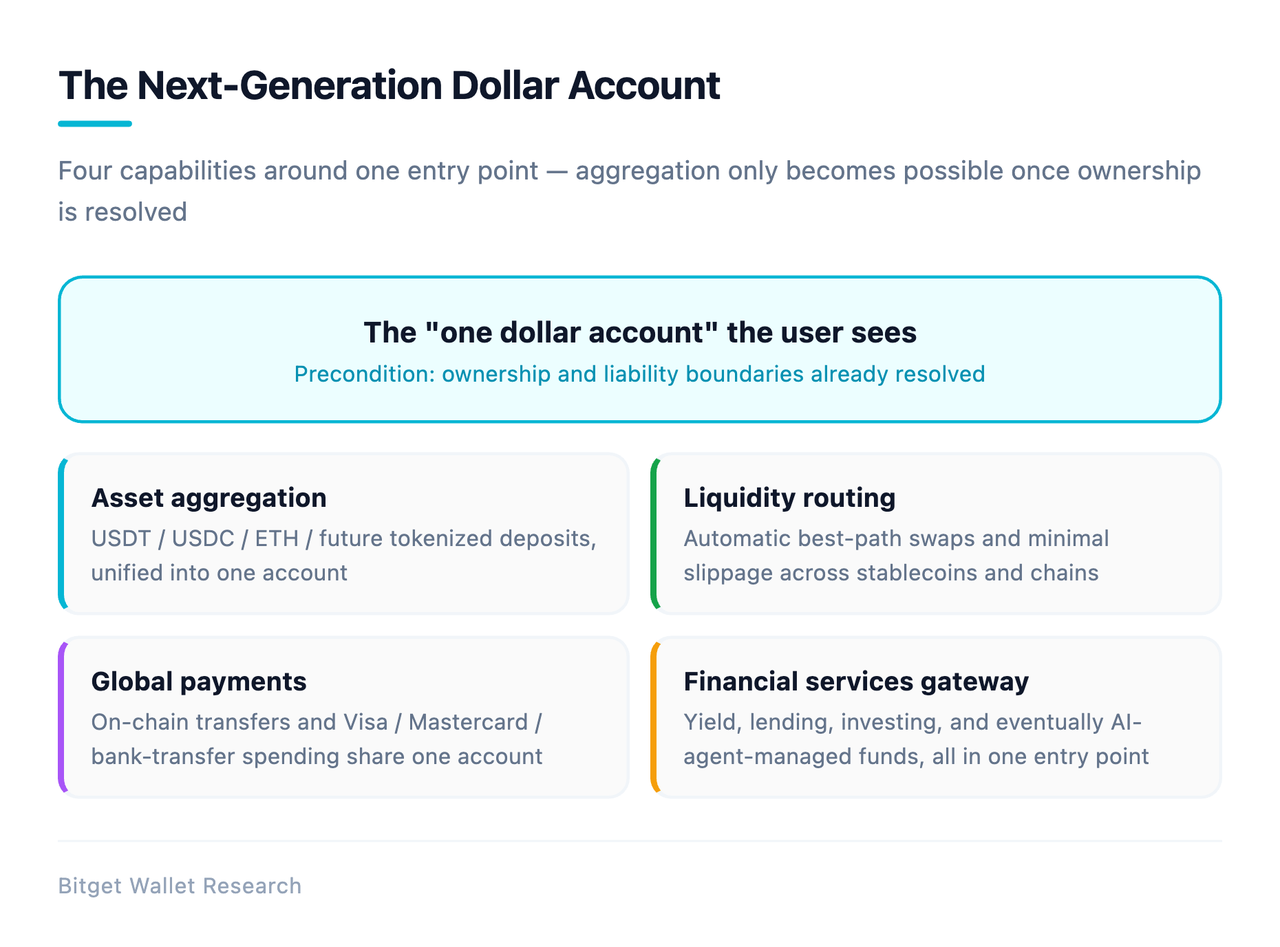
So "who owns the account" evolves, under the pressure of stablecoin proliferation, into
"who can reassemble dozens of dollars back into one dollar in the user's eyes."
The products that can do this are building four capabilities at once: aggregating USDT, USDC, ETH, and future tokenized deposits into one account; automatically routing for the best rate and lowest slippage across stablecoins and chains; letting one account handle both onchain transfers and real-world spending via Visa, Mastercard, or bank transfer; and folding yield, lending, payments, investing – and eventually autonomous fund management by AI agents – into a single entry point.
All four rest on the question this article started with. You only earn the right to talk about aggregating many dollars into one experience after you've settled who owns the funds and who carries the responsibility. Because aggregation requires trust that the entry point won't quietly transfer asset ownership somewhere deep in the terms.
Users won't care whether they hold USDT, USDC, or a bank's tokenized deposit – just as nobody today cares which clearing system sits behind their balance. What decides the next generation of dollar accounts was never going to be whoever issues the most. It's whoever finds the balance point between leaving the bank and surviving regulatory scrutiny – one that users are willing to trust, and regulators are willing to accept.
That's what the account wars are
actually about.
Disclaimer: This article is for informational purposes only and does not constitute investment, legal, or financial advice.
 2026-07-21
 Bitget Wallet Partners with Mesh to Expand Crypto Payments
Recommended
 AnnouncementBitget Wallet Joins Japan's Largest Blockchain Council as Self-Custody Rules Evolve2026-09-11